Now, let’s see how atoms formed from dodecahedrons can look like.
Proton (Hydrogen)
Hydrogen, the proton. Later, in the section dedicated to molecular bonds, we will consider how 2 and 3 atomic hydrogen molecules H2 and H3 can be formed.
Deuterium
Hydrogen
isotope deuterium. Two dodecahedrons joint by their faces. Since the faces are
flat, there is no gap between them, which means there is no free ether between
the faces. The forces holding two protons together depend on the pressure of
the surrounding ether. The deuterium complex is very strong, since the
mechanical forces that may break its bond have a short lever arm.
The hydrogen isotope tritium 3H consisting of three protons, has twice the length of the arm, compared to deuterium, which makes tritium atoms less durable and therefore unstable, with a half-life of 12 years.
Tritium
The instability of the linear arrangement of protons in the tritium atom is especially obvious, if we compare it to the atom of helium 3.
Helium-3
The same three protons, but organized into a more compact structure, with a shortened length. This is where we first encounter the gap between protons. It would seem that the presence of gaps indicates the imperfection of our model. At least due to the fact that the atoms do not form a continuous dense structure and do not provide the ideal filling of space. The search for such an ideal packaging is one of the tasks of the corresponding branches of mathematics, geometry and topology. And the consideration of the properties of structures characterized by numerous gaps does not attract much attention of popular science. For our approach, the presence of voids is a required, absolutely desirable and necessary factor, since the gaps provide the possibility of the existence of the attached vortices of the ether.
Helium-4
If in
Helium 3 all protons are in the same plane, then Helium 4 looks like its
three-dimensional copy. Accordingly, instead of one slit, there are three.
On this
further advance of atoms in this direction is suspended. The addition of
another proton-dodecahedron leads to the creation of an unsymmetrical, and
therefore unbalanced figure. Such a figure has little chance to maintain its
shape during movements and collisions, and is unlikely to form periodic
structures such as crystals. Therefore, stable atoms with an atomic weight equal
5 are not observed in nature.
Consideration
of all possible combinations of dodecahedrons will require too much time; so
next we focus only on the structures of atoms of stable isotopes of substances.
The next
symmetrical figure, which can be composed of dodecahedrons resembles a rosette
and contains six protons.
The presumed structure of the atoms of Lithium-6. Top view and bottom view of the “rosette” formed by five dodecahedra around the central dodecahedron (proton). Lithium 7 differs from the one shown in the figure in that the cavity in the following figure is filled with the seventh proton. The result is a fairly symmetrical figure.
Lithium-6 Atom (Li 6)
Lithium atom 7, the addition of a proton inside the “rosette” makes the atom more symmetrical. Full symmetry, as we’ll see later, will be in the atom of carbon, which is different from the lithium atom 7, in that it has six additional protons. (Surprisingly six, Not five!)
Lithium-7 Atom (Li 7)
Another variant of the Lithium 7:
Then again follows the lapse, stable atoms with an atomic weight of 8 does not exist. The reason is the same as with the absence of stable atoms with five protons – the impossibility of creating centrally symmetric figure of eight dodecahedrons. It seems that there should be an additional condition that freely arranged linear chains of dodecahedrons cannot be composed of more than 2 dodecahedrons. This condition is well illustrated by the example of tritium, which is a chain of 3 dodecahedrons, and therefore is an unstable element.
Protons are
the smallest particles of substance (already substance, not just matter!). But
what causes the grains of ether to form identical ensembles, which preserve
their structure when moving through the ether, and preserve their structure while
connecting with other protons in various combinations forming atoms?
The
following answer to this question is proposed:
The
structure of the proton is the smallest possible three-dimensional figure
(cluster) composed of ether grains, which allows to withstand against external
strikes and redirect these strikes coming from the outside, from the free
ether, so that all the grains of the cluster retain mutual engagement and move
as a whole.
Such a
figure is most likely a dodecahedron, as having the shape closest to the ball
of all Platonic bodies (regular polyhedra).
This
structure assumes the absence of internal voids (taking into account the
process of formation by compression), and most importantly, the outer layer
(shell) of such a structure should be formed by “snapping” ether grains tightly
with each other. That is, at a certain stage of increasing the size of the
dodecahedron constructed from the same balls (grains) of ether, there should be
a situation in which there are no voids inside the cluster, and in which the
faces are close enough to the ideal planes, and the edges of the dodecahedron
are composed of an integer number of grains.
The size of
such a structure should be unique and unambiguous, that is, the repetition of
the coincidence of all the above conditions for some other (larger) size should
have too much mass at the existing ether pressure. It would be very interesting
to find an algorithm or formula to calculate the number of spherical grains
satisfying the conditions of formation of such an ideal dodecahedron. By the
way, this amount will be equal to the ratio of the ether’s grain size to
proton.
The
stability of the structure (“lock”) in this case is provided by the external
pressure of the ether surrounding the proton. The external pressure, that
maintain the structure of the proton, applied to the protons from the
surrounding gaseous ether. This mechanism is somewhat similar to the phenomenon
of surface tension, if we imagine that the attraction of the outer layer of
ether grains to the inner is due to the absolute vacuum between the ether
grains.
In cases
where the proton is a part of a structure of atoms, the external pressure of
the ether is applied to the proton not only directly from the surrounding
ether, but also through other protons with which it comes into contact in the
atom.
Thus, the
same mechanism of maintaining the structure works at the next structural level
of matter – the level of atoms. That is, nucleons in atoms are also held
together by the external pressure of the ether.
Such a
world order looks at first glance quite fragile / ephemeral, since the
stability of the substance depends on the pressure of the ether. But it is this
circumstance that allows to close the chain of mutual transformations of ether
– substance – ether, and ultimately is the material basis of dialectical
variability and infinite diversity of our world.
At the same
time, this model explains the observed uniformity of the structure of substance
in all parts of the universe. This uniformity is based on the identity of all
the grains of ether.
Our model
of the proton and the atoms requires the pressure of the ether, to be above a
certain minimum threshold. When the pressure of the ether falls below this
threshold, the stability of the substance is not provided.
It is
obvious that such a mechanism has some limited range of stabilizing feedback.
Reason: as
the external pressure decreases, the external effects on the protons also
decrease, i.e. the external shocks have a lower intensity, which helps to
maintain the stability of the substance. But this balance is broken at some
threshold minimum pressure, when the external pressure is not enough to hold
together the ether grains, and even a rather weak external impact leads to knocking
out the grain, since the external pressure does not compensate for the impact.
The same
can be said about the increase in the pressure of the ether, there is a
threshold at which the average external pressure becomes insufficient to
compensate for individual impacts on individual grains entering the proton.
This scenario is realized when the temperature of the substance increases, i.e.
the speed of rotation of the attached vortices of the ether.
Let us now,
based on this model, consider the main structural stages of the material world:
The first structural level of matter – ether grains which located in absolute space. Free Ether.
The second structural level of matter – protons (already substance) – clusters of ether grains, held together by the external pressure of the ether.
The third structural level of matter – atoms: clusters of protons held together by the external pressure of the ether.
The fourth structural level of matter – molecules– clusters of atoms, held together by the ether vortices which accompanying atoms, what is commonly called electric forces.
As we can
see the ether pressure plays a significant role at all structural levels of the
organization of matter, including chemical (the fourth in our classification).
Chemical bonds ultimately depend on the pressure of the ether, since the
parameters of the ether vortices certainly depend on the ether pressure.
In this
regard, we can mention the research (effect) of S. E. Shnol, who discovered the
dependence of any chemical and nuclear processes on cosmological factors, which
is the pressure of the ether surrounding us.
We should
also mention the Casimir effect, which is a direct confirmation of our model of
the substance based on the structures held together by the pressure of the ether.
And also
note that our model gives an explanation of the so-called strong interaction,
its paradoxical property to act only at close distances.
Going back
to the structure of a proton – generally speaking, the shape of a proton can be
quite simple, starting with four ether particles (a tetrahedron, a
dodecahedron, or a cube). This simple form should have a complex internal
structure. The convex smooth surface is not suitable; the necessary surface is
composed of flat polygons, in order for effect of the “Magdeburg hemispheres” to work.
Let us
repeat that the key principle in this structure is the transfer of the blows of
the surrounding ether grains evenly in all directions inside the proton, which
allows to preserve its structure. Since the proton in collisions with ether
grains acts as a monolithic structure having a much larger mass than the ether
grains hitting it.
Proton-Dodecahedron:
Proton
The figures below shows the possible clusters of grains of the ether, which correspond to our model of the proton based on the assumption that the grains of ether are simple balls. To consider the grains of ether as balls is a well – founded assumption at the present stage of our ignorance, with the hope to return to this issue later, if there are prerequisites for this.
If an
additional grain, or a group of ether grains, joins any outer face of such a
cluster, they will be pressed against the cluster only if the surrounding free
ether grains collide with them at angles close to the normal to the surface of
the proton. It is obvious that any growths on the surface of the proton,
regardless of the method of their appearance will not be able to persist for a
long time, thus self-calibration of protons in size and mass, respectively, is
carried out.
If we trace
the history of protons, since their birth in the depths of stars and planets,
there is such a picture:
As a result
of the action of the gravitational vortex, a high ether pressure is created
inside the stars, which presses the ether grains to each other. A solid densely
packed monolith of ether grains is created.
When such a
monolith enters the layers coming to the surface of the star, with a lower
pressure of the ether, in conditions facilitating to its fragmentation, as a
result of the faults of the ethereal monolith, the fragments will have a very
diverse shape. Gradually, individual protons and atoms of more complex
substances will be formed from them, and all the grains of the ether that
turned out to be unrelated to stable structures will be sublimated into a free,
gaseous ether.
The degree
of compression depends on the degree of dilution of the ether, since the
decrease in the volume of the ether during condensation is determined by the
difference in the volumes occupied by the ether before and after condensation,
and if the ether particles moved having large free path distances, then the
degree of compression of the ether during condensation will be large,
determined by these distances.
And
finally, before finishing with the topic of general principles of atomic
structure, it should be mentioned that there is no fundamental need for atoms,
especially more complex atoms, to have a spherical shape. The shape of atoms is
rather close to the shape of crystals, with a layered structure and faces. This
form is in better agreement with the observed variety of properties and spectra
of substances, as well as with a fairly easy and widespread transmutation of
elements, both in biology and in inorganic nature.
As for the
stability of crystal-like atoms in comparison with spherical ones, the basis of
stability is laid at the level of protons, which have the shape of a
dodecahedron that is close to the sphere. These, stable at the level of atoms,
structures only need to be held together, keeping the possibility of modification
in their combinations. Such a restructuring of the structure of atoms would be
much more difficult if the atoms had a spherical shape.
A few words about the
structure of material substance before moving on to the topic of heat, because
the microscopic structure of substance determines the mechanics of heat and
electricity.
Structure of Substance
As always, at the
beginning concepts and then more detailed explanations.
Condensed (solidified)
ether forms the elementary particles. Elementary particles are impenetrable by
the gaseous ether, and therefore the ether flows around them, but do not
penetrates through them.
When we talk about the
flow of ether through any material body, we mean the passage of ether in the
space between atoms and through the gaps inside the atoms. Inside the atoms
there are gaps between the elementary particles that make up the atoms.
The more complex and
massive the substance, the more complex the system of gaps its atoms have.
Ether meets greater
resistance when flowing through the intraatomic space of such complex
substances, which is equivalent to greater atomic mass of complex and bigger
atoms.
All these conceptions
imply the existence of an absolute space in which both condensed and gaseous
ether is located and moves.
Particles (grains) of
ether are solid objects, that is, impenetrable to each other. In other words:
an absolute space with volume equal to the one grain of ether can contain only
one particle of ether.
The grains of ether
are usually in solitary state, that is, unconnected to other grains of the ether.
This gaseous state, we call free ether; in this state exists the ether that forms
the space (universe).
Grains of ether also
can be in a condensed solid state (phase). This state is characterized by the
absence of gaps between the ether particles, that is, their tight fit to each
other.
Two ways of
condensation of gaseous ether into solid phase are evident.
The first method is gravitational; it is implemented on a giant scale inside the gravitational celestial bodies, and is described in more detail in the section devoted to gravity.
The second method is realized in micro scale inside atoms. It has a mechanism similar to capillary condensation and has hysteresis. That is, the destruction of the monolithic ether and blowing out fragments and evaporation of ether from these cracks occurs at higher temperatures than condensation.
The monolithic state
of ether can be stable or unstable. Protons are stable, because their form
provides mutual protection to all grain from extracting by external grains of free
ether. (more on it in the next article)
Unstable solid state of
ether can be visualized similar to ice fragments, or clusters of ether. These
pieces of solid ether are exposed to the surrounding gaseous ether, which
constantly bombards the solid phase turning it into gaseous ether.
Obviously, protons and
all sorts of smaller and larger conglomerates of monolithic ether can be formed
as a result of gravity.
As a result of the
decay of the monolithic ether fraction inside intraatomic gaps, can be formed
only fragments whose sizes do not exceed the size of the cracks in which they
were condensated, i.e. smaller than protons.
The size of ether
particles is extremely small compared to the size of the minimum possible stable condensed ether conglomerate
(proton).
The particles of ether
(grains) can be visualized as simple indivisible elements that move in absolute
empty space, colliding with each other; similar to the normal gas as it pictured
by modern science.
Such a simplified
representation of ether grains makes sense, at least in order to stop at the
level of ether, and to avoid “bad infinity”, where each subsequent
structural level of matter would have an even smaller internal structure.
The schematic
representations described above are sufficient to answer the question in
principle: ”Why do heavy substances have a large mass (greater resistance to
ether accelerations)? “– Because their area and hence
“aerodynamic” resistance increases with the number of protons (the
smallest stable blocks of condensed ether).
This model also explains
another physical phenomenon: “mass defect”. Moreover, the existence of the mass
defect phenomenon naturally follows from this model, and is one of the
arguments in favour of the proposed model of substance in relation to explanation
of the nature of mass.
The defect of the mass
is explained by the circumstance that with the increase in the number of
protons comprising the atom, the resistance of the viscous friction of the atom
increases not in proportion to the number of protons, but to a somewhat lesser
extent.
Resistance to the
motion of atoms in the ether is a statistical parameter, and is determined by
the average drag of atoms streamlined by ether in all possible directions.
One proton (hydrogen
atom) has a single atomic mass, that is, on average it has a singular
resistance to acceleration in the ether.
The deuterium atom,
consisting of two protons, has an average acceleration resistance in the ether
slightly less than two separate protons. This is explained by the fact that in
two-proton deuterium atoms protons partially shield each other.
As the number of protons in an atom increases, the mass defect of the atom grows in value, as the number of shielded and shielding protons increases.
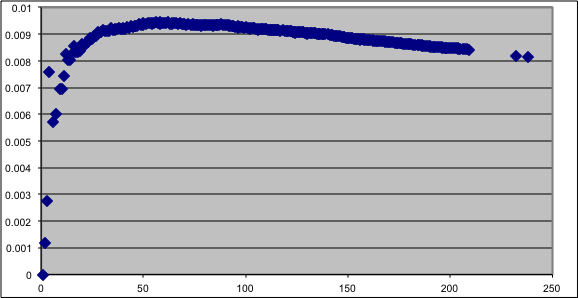
Mass Defect
The defect of atomic
mass depending on the atomic weight of the element (the graph is based on the
table of atomic weights of elements).
From a historical
point of view, such a parameter as the mass defect per one nucleon is of
interest. There are no special physical reasons for the increased attention to
this abstract value, but for the last 70 years it has been closely connected
with the popular belief in thermonuclear synthesis. In the scientific community
there was a widespread belief that the mass defect is a consequence of the
transformation of mass into energy. Huge efforts of society began to be spent
for search of a way of creation of helium atoms from hydrogen atoms in hope to
receive as a result an output of energy.
The energy released or
absorbed during the transformation of the substance depends on the type of
conversion and the amount of ether changing its phase state; the atomic mass of
the substance is of secondary importance.
The author
deliberately tries to avoid the term “nucleus” and to use only the
term “atom”, since supposes that there are no nuclei in atoms as it described
by popular science, because there are no electrons as particles of substance.
What science takes for electrons are ether vortices of a special form, that is,
it is quite material formations, but not substance.
The mass defect per
one proton decreases with each subsequently added proton in full compliance
with the geometry, since the shape of the atom will approach the spherical one.
In this form of the atom, the difference between various directions of blowing
is statistically levelled.
And after the atoms reach the order of fifty-six protons, the degree of influence of each new proton begins to decrease, since the added outer protons shield the inner protons to lesser extent (due to increased sizes of inter-proton gaps), which we observe on the graph of the defect of the mass per proton depending on the number of nucleons in the atom. (The graph shows only stable isotopes)
Mass defect per nucleon depending on the atomic weight of the element
So, the
atomic nucleus consists of a single kind of nucleons, which we will continue to
call protons, implying a completely different meaning. A distinctive feature of
our protons is the possession of the attached etheric vortices. And neutrons,
in our understanding, are the same protons in the free state, which do not have
attached etheric vortices (the differences between neutrons and protons will be
considered later).
Today, astronomy has no understanding of how globular clusters formed and why they continue to exist at present time, while maintaining their configuration.
Some properties of
globular clusters:
1. The structure of
globular star clusters is stable. Moreover, it is invariable. The stars that
make up the cluster are motionless. They are motionless relative to each other,
and the cluster itself is also static.
2. There is No dust in
globular clusters
3. The distribution of
clusters around galaxies is almost spherical.
Being on the positions
of the official doctrine, it is impossible to comprehend what prevents the
gravitational collapse of these conglomerates, but the official science is
trying to get out of the situation by assigning to the globular clusters giant
size.
For the beginning the
note, that for a better understanding of this section, you must first
familiarize yourself with the theory of the structure of substance from the
standpoint of the Law of Mechanics.
Here we just mention
that the Law of Mechanics proposes that there is a special form of matter – a
monolithic ether.
In contrast to the
usual substance, which is permeable to the gaseous ether, monolithic ether is
impermeable, since inside it there are no gaps or voids through which the
gaseous ether could seep.
Consequently, the
movement of macroscopic bodies consisting of a monolithic ether requires a displacement
of a large volume of gaseous ether. For sufficiently large bodies of monolithic
ether motion relative to the ether is almost impossible.
In other words, the monolithic ether has a mass close to infinity, and its acceleration in the ether requires forces tending to infinity. This almost infinite inertia of the monolithic ether leads to the circumstance that the bodies consisting of the monolith ether cannot move through the gaseous ether and always move with the gaseous ether.
In general, the topic
of monolithic ether requires special consideration. This is a completely new,
yet hypothetical state of matter, the existence of which is predicted by the
Law of Mechanics. As far as I know, the very possibility for substance to be in
a state similar to monolithic and be impervious to ether has not been
previously considered. The properties of such substances must be quite
extraordinary.
Imagine that such a
substance was on the surface of the Earth. It is likely that gravity will push
it down to the planet’s core. To keep the body formed from such a substance on
the surface will be possible only if it is possible to resist the pressure of
the ether moving in the direction of the center of the Earth. The smaller the
transverse dimensions of the body, the less resistance it should have to the
gravitational flow of the ether. What is the total pressure of the ether is not
yet clear; it is also unclear whether the ether can flow around macroscopic
obstacles, if it is not possible to seep through them.
It is possible that
the very core of large celestial bodies with gravity, consist of an ethereal
monolith. Star cores – most likely. The hypothesis of the ethereal monolith
allows us to give unforeseen by simplicity and
obviousness explanations for many puzzles and unsolvable questions observed
both in remote places of the universe and very close. But more about that sometimes
later.
In the meantime, back
to the globular clusters.
Although the existence of the ethereal monolith is questionable, there are indications of the reality of the presence of such a state of matter, and one of them is the globular clusters and their evolution into open clusters. It is possible that there is some other explanation for the properties of globular clusters, also satisfying all the observed facts. But so far only the monolithic state of the ether in combination with the Law of Mechanics able to cope with the explanation of the properties of spherical clusters.
Messier 13 (NGC 6205) Globular clusters have completely inexplicable properties if they are analyzed from the standpoint of orthodox science.
The photo shows a
globular cluster Messier 13 (NGC 6205).
Description of the process of formation and development of globular clusters in accordance with the Law of Mechanics.
Globular clusters were
formed as an outcome of the collapse of large stars due to the pressure drop of
the surrounding ether to a critically low level. The arising pressure wave of
the released ether causes the decay of smaller celestial bodies by the domino
effect.
The process of decay
is somewhat similar to the hypothesis of the disintegration of the planet, the
pieces of which presumably formed a belt of asteroids.
Here again we return
to the idea of how fragile is the balance on which the planets, stars and the
substance as a whole are built. Everything is held by external pressure, and in
case of its weakening, or a sharp change, the structure of the planet or atom
or proton may disintegrate.
For the planet it is
enough to get between two oppositely directed flows/vortices of ether, to
experience the bursting effect of the ether. Planets having the misfortune to
be in these conditions risk being torn to pieces. Apparently the size of the
planet should play a role in determining the fate of such a planet, because the
own gravity of a large planet will keep it intact. In this case, we can have a
planet escaped from the galactic plane and joined the galactic halo.
All of these scenarios
may be related to the fragmentation of superstars as a result of the depletion
of the ether, and the presence of a large number of globular clusters inside
the nebulae may indicate just such a process. Under certain conditions, the
nucleus of the galaxy disintegrates, sending a shock wave in all directions
from itself; this shock wave of the ether can be the cause of the breakdown of
many stars and planets included in this system. As a result, we will have a
nucleus-free galaxy containing a large number of globular clusters in a cloud
of dust, something similar to the Large and Small Magellanic Cloud, and
possibly the Milky Way Galaxy.
The described scenario
allows to explain the observed properties of globular clusters.
Composition: almost
free of heavy elements, almost pure hydrogen and helium. This may be the
result:
1) The initial total
decay of material bodies smaller than a few kilometres, that is, the guaranteed
decay of complex gases and dust. As a result, the globular clusters contain
almost no heavy elements, and only hydrogen and helium remain.
2) Slow evaporation of
the monolithic ether of which the large fragments consist. As a result of this
evaporation, free gaseous ether and protons are formed. The free ether slowly emanating
as a result of evaporation causes a gradual expansion of globular clusters and
thus the evolution of close globular clusters into open clusters.
3) Fragments of the
ethereal monolith pass through the process of grinding the protruding parts,
and turning into balls. This is one of the processes leading to the formation
of spherical shapes in celestial bodies. (Other processes leading to the same
result — the formation of spherical shapes in celestial bodies will be
considered in the relevant sections.)
Now about the
possibility of rotation of fragments of the superstar, which consist of monolithic
ether. It is obvious that the linear motion of large blocks of monolithic ether
relative to the gaseous ether is impossible due to the impermeability of the
monolithic ether. But the rotational motion of a spherical body does not
require crossing the ether (penetration through the ether). Globe of monolithic
ether, displaced the gaseous ether, has the ability to rotate without
experiencing significant decelerating and centrifugal forces.
Decelerating will
depend on the degree of roughness of the surface, and how it differs from the
ideal ball. Perhaps this imperfection in combination with roughness can explain
the red or yellow glow of some objects in globular clusters. These objects have
rotation unlike their white neighbors, which only reflect light.
A very interesting
property of bodies consisting of a monolithic ether should be the absence of
centrifugal forces. As a result, you can have almost unlimited rotational
speed…
Fragments consisting
of a monolithic ether can possibly glow without rotation, simply evaporation of
the monolith into hydrogen and the transformation of deeper layers into some
heavy elements. It is possible that both of these processes are accompanied by
the release of light. That is, there may be another process of illumination of
stars, in addition to gravitational.
Unlike gravity, the
process of evaporation (melting/sublimation) of the monolithic ether has a
limitation on resources; the process can only continue until the monolith is
used up. I.e. internal reserves, limit the process duration, the influence of
the external pressure of the ether is less important. In contrary to Gravity,
which uses external reserves of ether, which are almost unlimited.
The shape of globular
clusters repeats the shape of the ethereal “bubble”, which is formed
when the ether is released during the decay of stars and planets. We can say
that the substance suddenly converts into space (monolithic ether transforms
into gaseous). The emerged space is expanding carrying the fragments of the
monolithic ether. Having expanded up to the pressure of the surrounding ether,
the newly released gaseous ether stops, and with it all the bodies consisting
of the ether-monolith stop.
Further expansion of
the globular cluster is very slow. And since the “stars” of the
monolithic ether do not have gravity, no movement within the globular clusters
does occur, except for the only available method of movement — rotation.
Accordingly, the
distribution of globular clusters is also spherical, since it is subject to the
motion of the ether released from the nuclei of “galaxies”.
The image of the galaxy
NGC 1365 shows the central spindle-shaped vortex, the axis of which lies in the
plane of the galaxy, and two spiral vortices attached to the poles of the central
vortex. Spiral vortices also rest in the plane of the galaxy.
The superstar located inside the cocoon of the central vortex rotates in the transverse direction to the galaxy plane. Superstar is actually acted as a gyroscope with a fixed position of the axis of rotation in space. This ensures the fixation of the position of the galactic bar in space. From this we can conclude that in front of us is a relatively recently formed spiral galaxy, which has fully completed the transition to a spiral structure and has already managed to accumulate a significant amount of gas-dust matter.
NGC1365
Let’s take a closer
look at the process of forming a galaxy from a solar-type star system.
The first figure shows
the growth of the star accompanied by a slowdown in the rotation of the star,
and the growth of the quantity and size of the planets-satellites of the star.
The first figure shows the growth of the star accompanied by a slowdown in the rotation of the star, and the growth of the quantity and size of the planets-satellites of the star.
The second figure shows the state in which the position of the axis of rotation of the star changes under the influence of the incoming ether flows created by the grown satellites. This process starts after the planets satellites reach a certain critical size, and the crowded arrangement of these planets creates a tipping moment.
The third figure shows the resulting state of the system, in which the axis of rotation of the star already lies in the plane of the galaxy, that is, perpendicular to its original position.
At the same time, the
rotation of the star, which now can be called the galactic center or the
nucleus of the galaxy, slows down even more, as the rotational acceleration
from the equator stops completely. There is only rotational acceleration in the
region of the poles, but this acceleration must overcome the deceleration
caused by the lack of synchronous rotation of the ether in other areas of the
surface of the star. As a result, the rotation of the galactic center may stop
altogether, but the surrounding ether will still participate in the vortex
motion caused by the absorption of the ether by the galactic center.
Necessary clarification – the central star of the galaxy itself does not directly absorb the ether, but only participates in the process of condensation of the ether. The ether is condensed by the system (structure) consisting of the central star and the surrounding ether vortex. Therefore, the name galactic center is very appropriate for the central star, as it is only part of a more complex structure.
Two circumstances
explain the steady state of the galaxy’s arms in the galaxy plane.
The first is the
residual action of the GV (Gravitational Vortex), which previously provided retention
of all the satellites of the star in the plane of its ecliptic. This fading
ethereal vortex defined the initial location of the two new ethereal vortices
in its plane.
This influence was of
limited duration and ended with the end of the transition period from
Kepler-type to galactic-type GV.
The inertial action of
the Kepler Vortex also determined the direction of axial rotations of the
galactic sleeves and the direction of their spiral bend.
The second reason why the galactic sleeves are in the same plane is their mutual attraction. The mechanism of such attraction is illustrated by the figure.
Opposite directed
rotation of the ethereal vortices of the galactic sleeves leads to the development
of a reduced ether pressure between the sleeves. Therefore, the sleeves move in
the direction of lower pressure. Thus, the sleeves are attracted to each other
to form a common plane. After analysing the figure with a schematic
representation of the spiral structure, we can see that all the sleeves of the
galactic spiral always border on the opposite rotating sleeves, that is, the
spiral nebula forms a very dense “package”, which tends to
self-compression.
The fading Kepler
Ether vortex drags the sleeves into the plane of the Ecliptic, and twists them
at the same time. This is a transitional and relatively short-term process. As
soon as the Kepler gravity vortex’s reserve of inertia is exhausted, the galaxy
is left to itself. Its form is maintained in the form in which it has managed
to be, and new formative effects are beginning to play a major role.
These effects, as
already mentioned, are mainly determined by two polar etheric vortices
belonging to superstar, which lies on its side and rotates very slowly. The
gas-dust substance produced by a superstar accumulates in the space surrounding
it. This new material forms a kind of atmosphere around the galactic nucleus.
The presence of this atmosphere allows us to see the shape of the ether
vortices generated by the superstar. As in ordinary planetary atmospheres, the
intrinsic pressure of gas-dust matter resists gravity and prevents the fall of
matter on the surface of the Central body. This explains the paradox of the
movement of clouds of gas and dust in the direction from the galactic center,
with the predominant direction of the ether to the absorbing superstar.
In this regard, it is interesting to consider the situation with the galaxy UGC1382, in which the galactic ether vortex is not yet fully visible in the optical range due to the insufficient amount of accumulated gas-dust material.
At left, in optical light, UGC 1382 appears to
be a simple elliptical galaxy. But spiral arms emerged when astronomers
incorporated ultraviolet and deep optical data (middle). Combining that with a
view of low-density hydrogen gas (shown in green at right), scientists
discovered that UGC 1382 is gigantic. Credits: NASA/JPL/Caltech/SDSS/NRAO/L.
Hagen and M. Seibert. Only
photos taken in the ultraviolet spectrum allow us to see the true size of the
ethereal vortex formed by the central star of the galaxy. It can be assumed
that as a superstar produce the new substance; the ethereal vortex will be
filled with gas and dust material further and further, and eventually become
available for observation in the visible range.
It is feasible that
some irregular or pecular galaxies may represent galaxies at different stages
of the transition process from the Kepler-type vortex to the galactic one.
Galaxies with polar rings
Another example in support of our hypothesis about the structure and mechanism of formation of galaxies are so-called galaxies with polar rings. One of these galaxies NGC 4650A is presented in the photo.
For comparison, one of
the drawings illustrating our hypothesis is placed nearby. The picture reversed
to match the direction of twisting of the arms of the galaxy. The similarity
with our scheme is quite obvious. It can be concluded that the galaxy NGC 4650A
is at the stage when the rollover of the superstar has already completed, and
its axis of rotation coincides with the galactic plane. The superstar maintains
a rotation speed sufficient to keep a noticeable equatorial vortex that is
filled with gas-dust matter. Apparently, the revolution of the superstar
occurred at a relatively early stage, due to a large mass of satellite planets,
“successful” combination of orbital positions of which initiated the
rollover of the star. The photo really shows numerous planets and their groups.
Especially large groups of planets are just in places where begin to form the
sleeves of the galaxy. Over time, the central star of the galaxy will slow down
its rotation and its equatorial vortex will shrink and change its shape from
disk to elliptical / spindle-shaped; most of the gas and dust will be
concentrated in the sleeves, which will increase its length and density, and as
a result we will have an ordinary spiral galaxy.
In this regard, the galaxy NGC 660 is of interest, which is just at the stage when the axis of rotation of the Central superstar has not yet fully turned to a position parallel to the galactic axis.
Accordingly, the axis of the Equatorial vortex is in a transitional state from a perpendicular position with respect to the galactic vortex to the position coinciding with the galactic vortex. As in the previous case, there is a large number of satellite planets and they are accumulated at places on the galactic plane from where the beginnings of the sleeves can be traced. And there is a lower density of gas-dust matter in the galactic plane compared to the equatorial plane of the galactic nucleus, indicating a greater age of the Equatorial vortex compared to the galactic vortex. Also visible the ring around the galactic center in two places of which the beginnings of the two opposite sleeves already formed.
The ubiquitous law of conversion
of quantitative changes into qualitative…
The gradual
deceleration of the rotation of a large star leads to a slowdown in the
rotation of the gravitational ether vortex. Before the vortex provided stable
rotation of the star due to the balance of acceleration and deceleration acting
simultaneously to the core of the star (see section on tachocline).
But as the speed of
rotation of the star decreases, the ratio between the speeds of rotation of the
ether in the polar and equatorial regions of the stars changes. The
predominance of the equatorial velocity gradually becomes negligibly small. Now
those velocities are practically equal.
Superstar almost does
not rotate.
The ether in the equatorial
regions moves nearly vertically, with a very small tangential component, which
leads to the appearance of inhibitory forces opposing accelerations. All these
processes can be classified as internal, relating mostly to central star itself.
But there are also
external processes related to the system around the star. Qualitative changes
are also taking place here. While the growth of the central star has stopped,
the growth of the planets within its system continues. Finally, there comes a situation
when the gravitational balance within the star system is shifted towards an
ensemble of planets that have grown to the size of competing with the size of
the central star.
As a result, the star
is capsized; its axis of rotation lies down in the plane of the Ecliptic of the
former star system. This process is quite smooth, as there is a simultaneous
change in the position of the axis of rotation of the star and of the ether
vortex, which provides this rotation. According to the Law of Mechanics, the
star will experience internal stresses only in cases when there are
accelerations of the ether inside it. So the star itself is not deeply affected
by the rotation axis of the rotation by 90 degrees.
But you can imagine
that for the satellites of the star such a restructuring is equal to a
universal catastrophe. In any case, the world around them, to put it mildly,
ceases to be the same. The resulting galactic structure has a very stable
orientation in space, as the central star continues to play the role of a
gyroscope, despite its very slow rotation.
But, if earlier the
gyroscope of the star stabilized the position of the axis of rotation of the
entire star system, and the rotation of the satellites of the star was clearly
visible due to the huge distances they pass through the orbits around the star;
now the gyroscope of the star stabilizes only the axis of rotation of the star
itself, which can look like a galactic bar, connecting points of the origination
of two galactic arms.
Note that spiral galaxies
have only two arms coming from the nucleus. Additional sleeves, if any, are
formed as a result of division from the main sleeves. That is, spiral galaxies
always have two poles to which the sleeves are attached. Due to the described
structure, the movement inside the galaxy is almost undetectable, which
increases the impression of the immensity of galaxies and the distances to
them.
The loss of rotation
of the star is accompanied by the restructuring of the gravitational vortex
(GV). GV from the equatorial flat becomes spindly cross-polar. As a
transitional phase, galaxies of elliptical structure are formed, when planets
and stars (large planets satellites by this time already grown into stars) are
rearrange from Equatorial orbits into polar chains and conglomerates. The
vortex gradually acquires a flattened form, passing through a period of
turbulence.
The ethereal vortex converts
into galactic type, that is, it takes the form of a spiral galaxy. And it
spreads far in the vicinity of the superstar, not just where it can be seen due
to the dust it contains. The vortex again takes a flat form, but this form is
different from the original.
In the past, it was a
form typical to the young star system, such as the Sun. Two ether-vortexes meeting
in the Equatorial plane were sucking the ether out of the spherical volume,
forming an ultra-thin plane of the Ecliptic in which planets and satellites
have been collected.
The replacement galactic
vortex consists of two ether twisters directed to each other by their funnels.
They rotate unidirectionally with the star. But at a much greater angular
velocity than a slow star. Dust accumulation in the form of a galactic bar is
formed by suction of dust and gas into a spindle-shaped vortex located along
the axis of rotation of the star.
Thus stellar evolution
enters its third phase, where the star remodels the form of associated ethereal
vortex.
The Central star,
which became the core of the new “galaxy” (nebula) is no longer
growing. But the structures surrounding the core, the most prominent of which
are the gas-dust sleeves, grow in size.
Planets and stars located
inside gas-dust sleeves continue to grow, but their growth is less noticeable
than the growth of the sleeves, so the sleeves are much larger than the celestial
bodies inside them.
If the stars located
in the sleeves of the nebulae grow to the size of superstars, they, in turn,
can begin to rebuild their gravitational vortices into the polar (galactic)
type. This leads to the budding of the young galaxy from the old one.
There is an abundance
of cosmic images illustrating the described scenario at its various stages of
development; from the rudimentary daughter vortex inside a mature galaxy, and
to the fully formed young galaxy associated with the mother galaxy. There are
also more complex systems consisting of several galaxies.
What’s next? Some
stars that are in the galactic sleeves, experiencing insufficient ether
pressure, due to the intense competition from the surrounding stars, and as a
result break up, forming globular clusters within galaxies.
In the process of breakdown,
dust and gas decay, as these are the most unstable bodies, due to their small
size. Large pieces of superstar more sustainable and evaporate with less
intensity. The result is a clean space, free from dust and gas, and occupied
only by large spherical fragments.
And superstar
(galactic center) is also falling apart. This is confirmed by the existence of
nuclear-free galaxies.
For the star itself,
this (fourth) stage of evolution is the last, after which the star ceases to
exist as a single object.
The scenario of the
fourth stage of stellar evolution (the process of superstar decay) will be
presented after the section devoted to the structure of matter. Since for its
understanding, it is necessary to get acquainted with the concepts of the
structure of atoms from the standpoint of the Law of Mechanics. Therefore, the
decay phase of the galactic nebula core is not yet considered.
Thus, stellar
evolution supplemented by the galactic period in accordance with the Law of
Mechanics consists of three sections:
The first phase includes the period of growth of the planet since the acquisition of gravity, in this part, the growth of the planet is accompanied by an increase in the planet’s own rotation and the temperature of its surface until it reaches luminosity (i.e., transformation into a star).
The second section is the period of growth of the star, since the appearance of luminosity, in this area the growth of the star is accompanied by a slowdown in its own rotation, while maintaining the temperature (and, accordingly, the spectrum).
The third section is accompanied by a decrease in the speed of rotation of the star to a critical one, at which the gravitational vortex changes its structure, and the size of the star reaches the limit at which the star turns into a galactic nucleus. The galactic nucleus no longer grows, but only produces the energy and matter scattered around the galactic center.
The main difference
between the evolutionary sequence of stars according to the Law of Mechanics is
the opposite (in comparison with the Main Sequence) direction of stellar
evolution. So according to orthodox science, stars evolve from yellow to red,
and according to the Law of Mechanics, on the contrary, from red to yellow.
The third section is
not represented in any way in the generally accepted diagrams. Organized
science distinguishes galactic nuclei in a special category of objects, related
to “black holes”.
Typical Structures Of Galaxies
Let’s try to
illustrate what was said on the example of typical nebulae (galaxies),
considering them in the order of the probable evolutionary sequence.
Let us repeat the
basic definitions. Gravity Vortex (GV) can be of two types:
1) Equatorial, Kepler
that is, such that exists around the Sun, the plane of this vortex coincides
with the equatorial plane of the star, which in the case of the solar system
roughly corresponds to the plane of the Ecliptic. While the star is in the
second phase of its evolution, star’s axis of rotation is perpendicular to the
plane of the Ecliptic.
2) Galactic
gravitational vortex, the plane of this vortex also coincides with the plane of
the Ecliptic of the star system. But now it is the former Equatorial plane of
the Central star. This plane is preserved due to the fact that there are
satellite planets, which have a significant mass and inertia. And thanks to the
inertia of the ethereal vortex, which was generated by the star. After the axis
of rotation of the star has turned (relative to the Ecliptic) from perpendicular
to parallel position, its equatorial vortex (equatorial plane) no longer
coincides with the plane of the Ecliptic, but is perpendicular to it.
Ultra Slim Galaxy
For example, images of galaxies NGC4565 and NGC4594 (M104 Sombrero) are provided.
NGC4565NGC4594 (M104 Sombrero)
Apparently, these
galaxies are superstars that have reached the size at which they produce an
increased amount of dust and gas, but have not yet slowed to a critical speed
and therefore retained around them the usual gravitational vortex of Kepler
type.
It is possible that
such nebulae are formed mainly from stars that do not have large satellites,
which would contribute to the overturning of the Equatorial gravitational
vortex (GV) and its transformation into a spiral with two sleeves.
Elliptical galaxy
Some elliptical galaxies may represent the same hyper thin galaxies, but they are visible from a different angle, allowing us to study them in more detail. For example the galaxy ESO 325-G004, shown in the photo.
ESO 325-G004
As well as hyper thin
galaxies, elliptical galaxies are characterized by a small amount of gas and
dust, which is quite logical for superstars only entering this period and have
not yet developed a noticeable amount of gas and dust. Note the other galaxies
and stars that are clearly visible in this picture, behind the galaxy ESO
325-G004 and shining through its structure. It is very curious that this galaxy
is attributed to its gigantic size (more than 100,000 light years across) and
being at a monstrous distance from us (about 450 million light years), although
it is obvious that the stars shining through the gas-dust cloud can not be
located far away, which allows us to judge the size of the nucleus of this
galaxy, comparing it with neighboring stars in the background.
Speaking about the
size of the nucleus, it should be mentioned that the visible dimensions of the
nucleus seem larger due to the luminous halo arising from the scattering of
light on the gas-dust substance.
Galaxies grow due to
increase of gas-dust sleeves and growth of the celestial bodies entering their
structure. These growing celestial bodies – planets and stars, also contribute
to the gas-dust cloud of galaxies, releasing part of the substance formed as a
result of the absorption of ether.
Returning to the subject
of the stars in the background. According to organized science, these stars
experience a truly miraculous transformation because they are actually globular
clusters. Organized science gives stars an admirable ability to sense the
boundary between the state of a star and the state of a globular cluster.
Moreover, this boundary is determined in relation to the Earth.
Here is a quote from the description of the picture: “Hubble resolves thousands of globular star clusters orbiting ESO 325-G004. Globular clusters are compact groups of hundreds of thousands of stars that are gravitationally bound together. At the galaxy’s distance they appear as pinpoints of light contained within the diffuse halo.”
There is doubt looming
about all the other stars around us: how can we be sure that all the other
stars are not really globular clusters?
Another type of elliptical galaxy is the dwarf galaxy, which is likely is a type of globular cluster, which will be discussed in the section on star decay. Note that globular clusters consist mainly of stars and contain almost no interstellar gas-dust matter. That is, according to our classification, globular clusters are young formations, or rather newly born formations that began a second life. Although probably more correct to say a new life, as it is unknown how many cycles of growth and decay survived their substance so far.
The following photo demonstrates another elliptical galaxy SDSS J162702.56+432833.9
J162702.56 + 432833.9
Here we are mainly
interested in the absence of large amounts of gas and dust. Another interesting
feature of this galaxy is the apparent chaotic shape, despite its close to
elliptical overall shape. It is possible that we have before us a fairly early
stage in the process of transformation of an ethereal gravitational vortex of
the Kepler type to a gravitational vortex of the galactic type. The later stage
of this transition is described in the next section on spiral galaxies. Once
again, we emphasize that the determining factor in galactic evolution is the
amount of gas-dust matter, the more dust, the older the galaxy. And the age of
the galaxy should correspond to its size, all other things being equal.




 The Law of Mechanics