We have gathered enough information to assess the macrostructure of the universe.
At current
stage of development of the universe, the ether no longer requires any external
(in relation to the ether) influence for the formation of substance. The initial
impulse, if it existed, created the starting (very first) gravitational system
(the center of condensation capable of condensing the ether into substance),
and then continued self-development and self-reproduction of such systems.
The
evolution of ether consists of repeated cycles:
— celestial
body-embryo with gravitational reactor, which begins to grow;
— then the
planet, star, superstar; increasing the amount of substance causes depletion
(decrease in density) of ether;
— this leads to the release (evaporation) of the ether constituting the substance, and to the decay (implosion) of the superstar;
— the result is a multitude of scattering celestial bodies-embryos, which evolve into a star cluster;
— and the cycle is repeated in new places, multiplying over and over again.
The process of growth of star systems is similar to the growth of mycelium or mold, or the process of forest growth from a single seed. Therefore, the macrostructure of the universe has a fibrous appearance. For the emergence of substance (stars) in any part of space, which was free from the substance, there must other star to be formed first somewhere in the neighbourhood, and that star must advance thru full path of metamorphose from the embryo with the gravity generator of the substance to superstar, and then to disintegrate. That is, the substance forms a substance. A star can only originate from a previously created substance.
The described scenario is confirmed by astronomical observations of the largest cosmic structures of the Universe in the form of filaments from galaxies situating between the voids.
The universe within 500 million light years showing the nearest galaxy walls, superclusters and galactic filaments. The only thing we can’t agree with in explanation to this picture, – is the estimation of distances of hundreds of millions of light-years. Distance is greatly exaggerated by organized science.
In our universe there are no such structural units as galaxies. Since the galaxies (nebulas) are just the same stars at a later stage of development.
Here it is
appropriate to mention the concept of entropy, and the idea of thermal death of
the universe. In our picture of the world entropy, as the equalization of the
temperature (energy) of the universe has no physical meaning, and is completely
unimaginable.
Curious
question: is it possible to stop the movement of ether? Or put the question narrower:
is it possible to stop the process of transformation of ether into substance
and back? A kind of gravitational death of the universe, analogous of thermal
death.
The role of
the condition similar to the “death of the universe” can play the ether
devoid of substance, the ether in a state of maximum energy. This brings us
back to the topic of the Initial push with which we started this article, and
this topic requires special consideration…
Apparently,
once started, the self-oscillating process of converting ether into substance
and back is unstoppable. To maintain this process, it is necessary only to
maintain the pressure of the ether in the volume of the universe, or in other
words, to maintain the amount of ether in a given volume of the universe. This
condition requires either an infinite volume and the amount of ether in the
universe, or vice versa a finite amount of ether enclosed in a finite volume of
the universe. The main thing is that the volume of the ether of the universe
does not increase, which would lead to a decrease in the pressure of the ether,
and to the disappearance of the conditions necessary for the phase transition
(condensation) of the ether into the substance.
The evolution of ether takes place in space by changing (transforming) space. Substance, as a condition of the ether just migrates across the universe by the birth and decay. The process is somewhat similar to the cyclic chemical reactions of Belousov-Zhabotinsky that is a self-propagating, non-equilibrium fluctuations of concentration.
Galilean
invariance or Galilean relativity declares the independence of the laws of
dynamics from reference systems if these systems are inertial. According to
this principle, if in two closed laboratories, one of which moves uniformly in
a straight line relative to the other, to conduct the same mechanical
experiment, the result will be the same.
The law of
Mechanics rejects the principle of relativity as a superficial, abstract formation
that has no relation to physical reality.
The law of
Mechanics States that in real dynamics, accelerations act relative to the
ether, rather than accelerations relative to abstract space, as follows from
Newtonian dynamics.
The law of
Mechanics allows us to understand and explain the origins of misconceptions and
the reasons that caused the appearance of the principle of relativity.
The principle of relativity allowed to postulate the resolution of the contradiction between the observed motion of the Earth, and the lack of influence of this motion on any processes and experiments on its surface, without explaining the reasons for this situation.
The answer to the reason for the lack of influence of the Earth’s motion on the processes occurring on its surface gives the Law of Mechanics in its First consequence: the body at rest relative to the ether does not experience any effects.
In addition, the state of rest is considered from a somewhat different angle of view in the last consequence of the Law of Mechanics: If physical body is free in its movement, it is accelerated along with the ether without any inertia (or internal stresses and overloads). There is no stress inside the free body during any acceleration, change of direction of motion or sudden stop of the ether carrying the body.
In other words – free bodies (for example, such as our Earth) “do not feel” any movement or acceleration of the Ether surrounding them.
Consequently,
the Law of Mechanics allows us to abandon the principle of relativity, and thus
get rid of the many contradictions to which this principle leads.
Contradictions – starting with the inability to explain the absence of the
effects of uneven and curvilinear motion of the Earth, and ending with problems
in explaining electromagnetic and optical phenomena.
This once
again shows that the recognition of the Ether, and especially the adoption of
ether as a Reference System is in direct antagonism with relativism.
The main
reason for the appearance of the principle of relativity is the extremely small
deceleration of body by space when body is moving at a constant speed. That is,
the difference between the movement of man inside the ship (as described by
Galileo) and on Earth is completely indistinguishable.
From the
point of view of the Law of Mechanics, this difference exists, since the
movement on the Earth is carried out relative to the fixed ether, and the
movement inside the ship is relative to the moving ether (the motion of the
ether caused by the movement of the ship relative to the Earth ether). As a
result, the real speed relative to the ether for a person moving inside the
ship will be equal to the sum of the speeds of the person and the ship. But the
difference is almost imperceptible. The speed difference is equal to the speed
of the ship, and if we replace the sea ship with a space ship, the effect of decelerating
by ether will increase, especially if this spacecraft will move at a speed of
about thousands of kilometers per second.
So, going
back to the principle of relativity of Galileo, it is easy to understand why
Galileo made this mistake in his time, even now all these arguments are completely
non-obvious to most (hope not to all) people. The speeds available today are
still too small to be convinced in practice that the principle of relativity is
a fallacy. Although there are experimental data obtained at the accelerators, permitting
to suspect that something is wrong with the movements at high speeds…
Unity of Heat and Electricity and their structural-forming role
The
following section briefly explains one of the most important principles that are
necessary for understanding of the internal structure of material bodies from
the point of view of the Law of Mechanics. The internal structure here refers
to the organization of substance from the level of molecules, as well as the
mechanism of phase transitions: gas – liquid – solid. This principle also
explains the basis of the mechanism of chemical reactions. That is the
principle on which all physical and chemical processes, except nuclear, are
based.
The
principle is very simple: heat being ethereal vortices having a random
orientation for the body as a whole (i.e., at the macroscopic level), has an
ordered orientation (i.e., is an electric vortex) for an individual atom or
molecule (i.e., at the microscopic level).
Here we can
obviously see example of the dialectical principle of transition of
quantitative changes in qualitative upon reaching of a certain level.
For
individual atoms, heat is electricity, but for a sufficiently large number of
atoms, the sum of elementary electricity is heat.
The vortex
of the attached ether of each individual atom has the shape, direction of
rotation and orientation, which is characteristic only to this type of atom.
The shape of the vortex is determined by the geometric shape of the atom, and
since all atoms are composed of one basic element – a proton, the properties of
atoms exhibit periodic similarity. This is the physical basis of the periodic
table of elements discovered by Mendeleev.
So, to
paraphrase our principle: heat at the macro level —is the electricity at the
micro level.
Or a little
differently: heat consists of micro electricity.
Imagine a
simple substance consisting of the same atoms; let’s pick the simplest form of
an atom tetrahedron (for example, an oxygen atom). If each vertex of the
tetrahedron is the axis of the corresponding attached ether vortex, then even
for the correct crystal structure consisting of a set of tetrahedrons, the
total vortex of the attached (internal, in this case) ether does not have any
preferred direction of rotation. The preferred direction of rotation exists
only in the vicinity of each individual vertex of the atom. And in these
microscopic zones there will be an electrical interaction.
Thus, the
interaction of atoms is provided by a directional (i.e. electric) vortex of the
ether.
And the sum
of microscopic electric vortices turns into a macroscopic thermal cloud, as individual
vortices are mutually compensated because of their multidirectionality
(multidirectioness).
What will
happen if the velocity of the heat vortex (i.e. temperature) rises? Since the
temperature of the body is composed of the speeds of rotation of individual
vortices, each such speed increases accordingly. Here it is necessary to
carefully consider the consequences of increasing the speed of individual
vortices at the micro level. Each vortex, as we have already decided, is
electric, that is, it acts directed at neighboring atoms.
The
mechanism of this impact is discussed in more detail in the relevant section of
our work. In short, the higher the speed of rotation of the vortex, the greater
the force applied to the body from the ether.
Up to a
certain level, this increase in the speed of rotation leads to an increase in
the coupling forces between neighboring atoms. But a further increase in the
speed of rotation begins to have an impact on distant interatomic bonds. And
since the direction of these distant forces does not coincide with the
direction of close interatomic vortices, the temperature increase leads to the
weakening of these bonds.
Thus, there
is a certain optimal temperature at which the body has the maximum binding
forces between atoms, which is usually characterized by a minimum volume of the
body. This nuance helps to understand the reason why some bodies have
non-trivial dependences of the coefficient of volumetric expansion in some
temperature ranges, and especially, the increase in the volume of the body in
the solid state compared to the liquid (as water or bismuth).
In most
cases, an increase in temperature leads to an increase in the volume of the
body, until the temperature at which the interatomic bonds begin to decay,
which is a phase transition from solid to liquid. Such a transition requires an
increase in the speed of rotation of individual vortices to such a level that
the vortices of each individual atom neutralize the vortices connecting the
neighbors of their neighbors.
In this
case, each released atom frees its vertices. And vortices that were previously
fueled partially by neighboring vortices lose half (or part) of their velocity.
This loss of velocity must be compensated by the external heat supply, and the
body temperature remains constant despite the heat supply (latent heat), until
there is a complete replenishment of the velocity of all the vortices of the
atom to the previous level. This is a two-way balanced process that goes in
both directions after reaching the melting point in a given section (zone) of
the body.
A similar
process occurs during the phase transition of a liquid into a gas, but there is
never a decrease in the volume of gas compared to the liquid phase, since the
interatomic distances in liquids at boiling temperatures significantly exceed
those in solids, so that strengthening of interatomic bonds is out of the
question.
So the gas
phase is characterized by a complete absence of interatomic attraction,
apparently due to the additional rotation of atoms / molecules or ether around
them.
Let’s try
to reconcile this idea of the structure of substance with the statement of the
inevitable inhibition of the ether vortices due to its viscosity. The end
result of this should be a substance that is completely cooled, reaching zero
velocity of ether vortices. Will the solid structure of the substance be
preserved? Will there be inter-atomic bonding? The question is quite
speculative, since such conditions are practically unattainable even in the
farthest corners of the universe, where there will still be fluctuations in the
ether, which will provide a temperature different from zero. And the second
reason is that as the speed of rotation of the ether decreases, the
deceleration will slow down due to the decrease in viscosity, that is, it will
be a very long and extremely slow process of reducing the temperature,
somewhere at the very edge of the universe. A kind of cold death.
To the
benefit of proposed model, speaks the fact that solids become very brittle with
decreasing temperature, that is, the interatomic attraction in them declines.
Surprisingly,
heat turns out to be the essence that binds/glues together atoms of substance
in solids and liquids, and along with this heat at high temperatures separates
the atoms of substance in gases and plasma. Really: the union and battle of
opposites (unity of opposites).
At the
level of atoms and molecules, electrical phenomena are fundamentally
indistinguishable from thermal phenomena; differences appear at the levels of
larger material formations. That is, distinction of electricity from heat
progresses with an increase in the size of material structures (bodies), which have
ethereal vortices.
An electric
charge, like heat, requires a material carrier for its existence, around which
an affiliated etheric vortex is formed.
The
electric vortex, figuratively speaking, is a concentrated heat. These are the
same vortices of the ether, but united in continuous chains, driven into
rotation by external sources of motion.
The reverse
is also true: on atomic scales, thermal vortices are nothing but electric
vortices (charges). In the section devoted to heat, it was noted that thermal
vortices serve as glue binding atoms in molecules. If such an idea seems
implausible, it will be easier to accept electric charges equivalent to thermal
vortices as binding elements in molecules and crystals. This is the picture that
official science also draws.
The forms
and structure of electric vortices are very diverse depending on the type of
electrical phenomenon. All these phenomena are united by the same mechanism and
the common medium in which they occur – the movement of the ether, located in
the interatomic, intraatomic and molecular slits.
Let us
repeat the most important concept of the Law of Mechanics: heat, electricity,
magnetism and light at the atomic and molecular level are the same processes,
so there are a great many mutual effects between light — heat — electricity —
magnetism. Photovoltaic, thermoelectric, thermomagnetic, magnetoelectric,
magneto-optical, magnetostrictive and similar effects require a substance for
their implementation. Also, all these effects are based on the mechanical
interaction of the ether with the substance.
We mention
in this regard, the electrochemical effects, especially their property of reversibility: the absorption of
electricity by the substance changes the chemical composition of the substance.
Conversely, a change in the chemical composition of a substance creates
electricity.
The
electric vortex of the ether is structurally less stable than the chaotic
thermal vortices of the ether, due to the fact that the electric vortex is more
ordered (here we are talking about vortices on the scale of the conductor); and
also because electric vortices need a source that supports them; feeds and sets
the speed and direction of rotation.
Under
special conditions, electric vortices for quite a long time may exist
separately without replenishment from the source, for example, electrets, but
their existence is still limited and the results in the inevitable discharge.
The fundamental and unavoidable cause of the discharge is the viscosity of the
ether, which causes the vortex to slow down. Thus, any electric charge without
external recharge, in any ambient conditions (even in a vacuum) will constantly
lose its original speed of rotation, i.e. will discharge.
As well as
heat, electric and magnetic vortices can not be at rest in the same place of
free space on their own, that is, without a material carrier around which they
are formed.
Independent
electric (magnetic) vortices can only move through the space, which is free
from matter, in the form of electromagnetic waves.
Another
important idea that needs to be accepted for understanding of the nature of
electric current, is that for the propagation of electric current required a
particular environment, the environment having the property of conductivity.
Conductivity
is the ability of a material medium to form continuous (bound) vortices of the
ether within itself. Let’s talk about this in more detail.
The
material environment (matter) exists in two forms:
a) in the
form of free ether (i.e. ether in a state similar to gaseous)
b) in the
form of ether containing substance.
Ether in a
free state (devoid of substance) has the property of conductivity, but
nevertheless is not a conductor in an independent form, since there are no
centers of turbulence, which are necessary for the formation of local vortices
of the ether.
The
property of conductivity in the real sense has only matter in the form of substance,
and only in some of its states.
Depending
on the specific state of substance, allowing the formation and propagation of
ether vortices, we have different types of conductivity.
In general,
the conductivity of the substance is due to the presence of ether-filled
cavities. Ether vortices excited by a power source in the conductors form a
continuous structure. That is, the vortex motion of the ether can be
transmitted from the source to the load. A conductor is similar to a pipe
through which the vortex motion of a liquid or gas can be transferred from a
source of rotation to another location at a distance.
The
conductivity of solids (usually crystalline type) is due to the presence of
stationary overlapping cavities (gaps) filled with ether inside the solid
conductors.
The
diameters of electric vortices apparently determined by the size of the
cavities inside the body. The minimum diameter of the vortex is vanishingly
small, even in comparison with the size of the protons. The easiest way to
imagine an electric vortex in the form of a chain of vortices connecting the
atoms of the conductor and forming a continuous closed circuit between the
poles of the source of electricity. Thus, it is possible to present an electric
current in the form of a bunch of multiple vortices distributed over the cross
section of the conductor, or in the form of a single vortex occupying the
entire cross section of the conductor.
The
mechanism of conductivity of liquids and gases differs from the mechanism of
conductivity of solids by additional movement of particles, which are carriers of
vortices, which leads to numerous side effects.
Our
approach to the description of electrical phenomena is based on the Law of
Mechanics, namely the idea of the action of the space (ether) attached to the
body.
This
approach is fundamentally different from the orthodox theories of electrical
phenomena, which explain the interactions between bodies through abstract
electric and magnetic fields acting as intermediaries.
The law of
Mechanics interprets the action (force) as a result of the effect of ether on
the body, and this situation is especially evident in electrical and magnetic
phenomena. In these phenomena, the role of the acting “second body” is
auxiliary; the second body only creates conditions for electrical interaction, modifying
the state of the surrounding ether.
Briefly
repeat the main provisions concerning the internal structure of matter arising
from the Law of Mechanics.
The atoms
that make up substance constitute from condensate (particulate phase) of ether.
Atoms have
a structure similar to crystals polyhedra. The smallest crystal is a proton it
is also a hydrogen atom.
The atoms
of other, more complex elements are composed of protons in various
combinations.
Atoms
themselves are electrically neutral. Protons, and any derivative of them atoms
in its natural state do not have any originally inherent charge.
Further,
from the consideration of electrical phenomena it will be clear that the
concept of “charge” does not apply to the internal innate characteristics
(properties) of the substance. It is difficult to say whether there are any
innate/inherent properties of the substance at all, except for geometrical
parameters (size/volume of ether grains), all other properties of the substance
can arise as a result of its interaction with ether.
A charge is
a characteristic of a substance that depends on external conditions, similar to
such properties of a substance as speed or temperature.
In
accordance with established practice, we will consider electrical phenomena by separating
them into three main classes: electrostatics, electrodynamics and electron phenomena
(for which electron emission is required).
This
division coincides with our classification of electrical phenomena, based on
the differences between surface (electrostatics) and internal (dynamics)
electrical effects.
Electrons
occupy a special place in the hierarchy of electrical phenomena, as in most
cases, for the implementation of electronic effects vacuum is required. But the
more important difference between electron processes is the need for electron
emission. There are many emission mechanisms that result in a variety of
structures. All these structures, despite their different arrangement is called
electrons and their movement science explains all electrical phenomena.
The
approach of the Law of Mechanics is based on the point that electrons are not
included in the composition of atoms, that is, they do not exist inside matter.
In all known effects electrons are observed outside matter. The fact that
electrons are released by matter does not constitutes their presence inside the
substance in the same form as outside the substance. Electrons are formed on
the surface or near the surface of bodies, which causes the illusion of the
presence of electrons in the internal structure of matter.
Light
behaves like waves, but some light phenomena resemble the behavior of
particles. Let’s try to understand what waves can exist in three-dimensional
space and at the same time have properties representative of light.
For the
model we take the mechanism of formation and propagation of waves on the
surface of water — that is, the movement of particles of the medium along
circular trajectories.
Three
variants of wave propagation formed by circular motion of medium particles in a
homogeneous three-dimensional space are conceivable.
1. The wave propagates in volume — in all directions from the center, while the circles described by individual particles of the medium are constantly increasing as they move away from the center (since the wave must capture the entire volume). Such a wave should quickly fade away (dissipate). Therefore, we will not further analyze this option and its plausibility, since such waves quickly lose their energy and can not spread far enough.
2. The wave propagates in one plane, like a surface wave. It is difficult to imagine the conditions for the forming and maintenance of such a wave in a homogeneous three-dimensional environment, but for our analysis, the main thought is different — such a wave also can not spread far enough, since the total size of the wave is constantly increasing as it moves away from the center. This increase in the wave front causes a weakening of the wave energy. The rate of scattering (attenuation) of this wave should be less than in the first case, but the existence of such waves in a homogeneous three-dimensional medium requires impossible conditions.
3. The wave propagates in one dimension, in a straight line. Initially it is difficult to imagine such a wave. At first glance, it is not a wave at all, but a kind of particle, as it travels without loss of initial energy, maintaining its shape and direction of propagation. But nevertheless it is a wave, and its existence is quite natural, since it does not require additional special conditions, as it was in the first two cases.
Let’s take
a closer look at the structure of this wave.
As in the
case of surface waves, the particles of the medium move in a circle. The
particles return to their original position after they close the circle and
transmit their motion to neighboring particles in the direction of the wave.
The reason
why the medium particles move in a circle is that the energy (velocity) applied
to the medium particle exceeds the displacement limit that can be transferred
from the particle to the particle without causing a reaction (resistance) from
the group of particles in front. “Extra” energy deviates in all
directions from the center of displacement, forming a toroidal vortex moving in
a straight line.
The action
from one particle to another in the direction of the wave (toroid) is
transmitted after the particle at a given place completes its circular motion
and collides with the next particle. That is, the full motion transmitted from
particle to particle is carried out in a spiral. A general toroidal motion is
created from individual spiral movements.
The
toroidal wave shape formed by the circular motion of the particles of the
medium is produced in the most natural way, if we imagine how the wave on the
surface of the water will behave if it gets into three-dimensional space, with
absolutely equivalent degrees of freedom in any direction. In order to remain a
wave and maintain its movement (existence), the wave must curtail into a bagel
(torus) and continue moving in a straight line in the direction of the movement
of the center of the torus.
For comparison, we present an image of the smoke ring; a careful study of this image leads to the conclusion that the smoke ring does not consist of spirals but of individual toroids “inserted” into each other.
In our
model, light has two different speeds: 1) the speed of the ether inside the
wave and 2) the speed of the wave.
Let’s
analyze whether the proposed model can explain the known properties of light
and light-like radiation.
Laws of
light propagation.
The light
intensity decreases in proportion to the square of the distance from the light
source. If we imagine light as a set of individual waves / vortices — toroids
(photons) propagating in all directions from the light source, it is obvious
that the number of photons per unit of the surface facing the light source will
decrease with distance from the light source.
An
inversely proportional dependence of the light intensity on the square of the
distance will be observed. Since the surface area of the sphere is proportional
to the square of its radius.
This
pattern persists, but is not so pronounced if the photons move in the same
direction, parallel or almost parallel. The intensity of the light produced by
such photons will decrease very little as the distance from the source
increases.
This fact
explains why there may be an insignificant divergence of light rays, as well as
why these rays occur at all, despite the wave nature of light. Due to this, it
is possible to create directed beams of light using spotlights and lasers.
The energy
of an individual photon is barely dissipated in space.
The
wavelength of light is proportional to the diameter of the photon. At the same
time, the photon, like any toroid, has three different diameters, which are
mutually dependent on each other. Now we are interested in two parameters — the
diameter of the toroid tube (formed by the circular motion of individual
particles of the medium), and the outer diameter of the toroid formed by the
joint movement of all the particles of the medium involved in the movement. The
larger the diameter of the toroid tube – the larger the outer diameter of the
toroid. In the limit, the outer diameter is equal to twice the diameter of the
tube.
This
implies the existence of two types of motion and velocities that are
characteristic of such a wave:
a) the rate
of transmission of mechanical motion from one particle of the medium (ether) to
another in a circular motion inside the tube of the torus
b) the
velocity of the torus (wave / vortex) as a whole.
Next, we
consider two options explaining the constancy of the speed of light:
1. The speed of such a wave (the speed of the torus) will be determined not only by the speed of transfer of the motion inside the torus tube around the average position of the particle (in average position particle is at rest), but also by the speed of transfer of the mechanical motion after the completion of the cycle of motion in a circle.
In
accordance with the geometric laws of similarity, the size (diameter) of the
wave (torus) corresponds to the size (length) of the step from the circle to
the circle. That is, if the size of the torus (distance / circumference that
must pass the wave before it passes the movement forward) is increasing, then
the size of the step is increasing also. The smaller the wavelength (diameter),
the smaller the step size, but accordingly more steps need to be done to pass a
unit of a distance. In other words, the wave speed does not change with the
change of the wave size, as the number of steps compensates the step size. The
deceleration of the wave due to the increase in the circumference that must be covered
before moving on the next circle is compensated by the increase in the
displacement (step) of the wave between the circles. Here we base on the
assumption that the length of the steps between the circles is proportional to
the length of the circle, and the coefficient of proportionality is the same
for waves of any length (any diameter of the torus tube).
In other
words: the rate of wave transmission (mechanical motion) in the center of the
torus does not depend on the size of the torus, but is determined only by the
properties of the medium.
2. The
transmission speed of the movement inside the waves of ether is not constant.
The greater the initial speed of the process that caused the ether wave, the
greater the speed of the ether inside the wave. The higher the speed of the
ether, the smaller the radius of curvature of the wave due to the viscosity of
the ether. That is, waves / vortices (toroids), which comprise the light and
all other types of electromagnetic waves, have a different “internal” speed,
(the speed of the ether inside the moving toroid). The higher the speed of
ether inside the toroid, the greater the angle of deviation of ether grains in
collisions with each other; that is, the smaller the outer diameter of a donut,
and accordingly “step” of a donut in the ether. Thus, photons of smaller size,
having a greater cyclic speed of the ether make more steps than photons of
lower frequency. This leads to the fact that the speed of movement of the toroids
are the same for all diameters of toroids. Or using more familiar terms, the
speeds of photons of any frequency are equal to each other.
The
proposed mechanism of light formation allows explaining the known effects of
light. Doppler effect: the higher the speed of the body, which emits light,
relative to the ether – the higher the “frequency” of photons. It is
necessary to mention here that the “frequency” of photons in the
conventional sense is not applicable to our model, as well as the wavelength,
but we continue to use these terms at the stage of the initial description of
our model, to facilitate understanding.
We use quotation marks, as we talk about the frequency of photons, as in fact, photons do not possess frequency, such as the frequency of sound waves. It is more correct to speak only about wavelengths, although this is also not quite true, since photons are not waves in the conventional sense. Photons have a size that can be called a wavelength, but it is more correct to say that it is the diameter of a solitary self-moving vortex structure.
May be it
will be possible to determine the frequency with which the photon rotates, but
this frequency seems to be different from the frequency calculated on the basis
of the speed of light.
Cosmological
red shift: the ether is a non-ideal medium, that is, it has a viscosity that
causes a gradual decrease in the speed of the ether inside the photon, which
leads to an increase in the diameter of the photon, while maintaining its
speed.
The
dependence of the energy of light (photon) on frequency: the higher the
frequency, the higher the speed of the ether inside the photon, i.e. its
energy. Gamma radiation, or rather gamma photons, have a maximum internal
velocity of the ether, and therefore must demonstrate the maximum value of the
red shift depending on the distance (energy degradation). Accordingly, the most
low-frequency photons should have the greatest “lifetime”, which is
confirmed by the presence of low-frequency background radiation coming to us
from all directions.
Thus the
old photometric paradox (Olbers paradox) finds an explanation. The brightness
of the night sky is indeed almost uniform, but at longer wavelengths than
visible light.
Another
paradoxical fact is the phenomenon of the interaction of light with atoms,
since the size (wavelength) of photons many times exceed the size of atoms.
Photons in the form of single vortices (solitons) interact only with those atoms,
which are happened to be exactly in the center of the vortex motion. The size
of the Central part of the photon vortex must correspond to the size of atoms
in order to cause the interaction of light with the atoms of matter. This
mechanism allows to explain the existence of the red border of the
photoelectric effect and its statistical nature.
Consideration
of other lighting effects will be continued in the relevant sections.
We continue the theme of ethereal vortices formed around protons and atoms. Let’s start with hydrogen; a hydrogen atom is a single proton. If the proton were just a ball, there would be no restrictions on the direction of the ether vortices around it. The variety of these vortices would also not be limited. But most importantly, these vortices would not be stable; they would “slide” around the ball and would not have any preferential location, size and direction.
The situation with the dodecahedron is different; here we right away have restrictions on the direction and number of vortices. The shape of the dodecahedron determines the most probable location of the circumferential vortex along two parallel faces.
Ether eddy
around the proton by interaction with the edges of the dodecahedron form a two oscillations
with periods of pulses differing by two times.
Possible
six equal variants of locations of the vortices. Note that the main
distinguishing feature of these vortices is their stable internal dimensions
determined by the stable proton shape. The stability of proton shape and size
is the basis of the stability of atomic spectra.
For deuterium atom there are restrictions on the location of vortices, but remain close to hydrogen resonances.
The overall situation is qualitatively changing starting with Helium. So far we have been dealing with external vortices (for analogy with the external electron), and in helium atom appear internal slit-type vortices.
Helium 4, only two matched vortices are possible. The vortex around the Central proton will be in a counterflow with one of the vortices depicted.
Helium 3,
only two matched vortices are possible.
Helium atoms (Helium-3 and Helium-4) have space for only two matched etheric vortices; these vortices partially pass inside the slits and partially reach the surface of the helium atom.
Lithium
atom with a single external heat vortex and two partially hidden slit vortices
Starting with lithium 7, atoms have full-fledged internal (fully immersed in the gaps) vortices of the ether. Of course, these vortices can protrude from the slits, if the speed of the ether is large enough. But the location of the vortices is fixed. And the direction of rotation of the ether also has its limitations, since the vortices are interrelated, and can only exist in certain combinations.
Lithium-7. Dark blue color shows the location of the internal inter-slit vortex
So our model leads to conclusions that allow an analogy with the dominant doctrine. We have external and internal ether vortices that determine the properties and states of atoms. This is a positive factor confirming the correctness of the chosen path. Accumulated enough experimental evidences of the existence of some intra-atomic structures, which are called electrons and the properties of which are widely used in practice. It is possible that the proposed approach will be fruitful in explaining the observed effects and predicting new ones.
And finally, another very important feature of the proposed model of atoms: a simple and natural explanation of the origin of stable atomic spectra. Spectra in our model are a side effect of the existence of faces and edges on the surface of protons and atoms in general. As well as the presence of gaps between the protons that make up atoms.
In the gaps between the protons there are vortices of ether, like drafts or winds in mountain valleys. The Coandă effect explains why the gas jet adheres to the surface of the streamlined body. These jets are those attached vortices of the ether, which we described before.
The
presence of attached etheric vortices is a consequence of the impact of
external sources of etheric waves on atoms. Any perturbation of the ether coming
into contact with the atom, be it the sunlight or other mechanical action,
causes the origin of slit vortices as a result of the presence of non homogeneity
in the path of the ether wave. (Resonant slit vortices)
The fact that the inter-proton slits in atoms have stable dimensions explains the stability of the waves (wavelengths) that are emitted as a result of the interaction of the slit vortices with the surrounding ether.
The
structure of photons from the standpoint of the Law of Mechanics will be
discussed in the section devoted to light.
The
velocity of the slit vortices is the temperature that finally finds a
mechanically consistent and noncontradictory explanation.
Attached vortices in atoms exist practically always. Even in remote from the stars corners of the universe there are single photons and a minimum level of background radiation. That is, the temperature of atoms can only approach to zero, and can not reach it in practice. As a result, the process of radiation and re-emission of thermal photons never stops anywhere.
So far, in analyzing the Law of Mechanics and considering the interaction of substance and ether, we have dealt mainly with unmoving ether.
The
mechanical action of real bodies on the ether is very small, that is, the shift
of the ether in response to the movement of substance inside of it is very
small. Ether simply flows around the body, just as gas flow around moving
bodies.
The
explanation for this is very simple — the total mass of the ether is
immeasurably greater than the mass of any bodies, so the acceleration of bodies
relative to the ether does not cause a reciprocal acceleration of the
surrounding ether, but only leads to a reaction directed at them and local
swirls of the ether.
The
mechanical motion of the bodies does not have a symmetric effect on the ether.
The ether does not acquire a linear motion in response to the motion of physical
bodies through it.
The
situation with heat, electricity, magnetism and light is different.
In all
these phenomena, we deal with the movements of the ether caused by the
substance.
These
movements of the ether are limited, usually microscopic.
Therefore,
the interaction of macroscopic real bodies with the motion of the ether in such
microscopic scales usually do not lead to a consistent unidirectional mechanical
action, as is the situation for example in the case of gravity.
Microscopic
etheric flows set in motion only a microscopic body. For macro-bodies, micro
streams of air have mixed and non-simultaneous character, which only causes
internal mechanical stresses in such bodies.
When official
science explains the heat the consequences of heat actions are taken for
(swapped) the reasons. Heat is a microscopic vortex of ether, therefore as a
result of the action of heat only microscopic objects are driven– molecules and
atoms. Brownian motion allows us to estimate the maximum dimensions of bodies
that can be transported directly by ensembles of thermal vortices.
The law of
Mechanics allows to explain differently the nature of heat, electricity,
magnetism and light, and as a result to come to conclusions consistent with the
observed facts.
Our world
is material, and its primary basis (primary matter) is ether.
A substance
is formed from the ether and all interactions of the material world are carried
out through the ether.
One of the
main ideas that the Law of Mechanics brings to the understanding of matter is
the idea of the creation of substance as a result of the transformation of the
ether.
Substance
is only one of the varieties of ethereal forms and movements. Today we know many
of these forms and movements: substance, light, electric and magnetic fields,
gravity (accelerated motion of the ether on a macro scale).
Heat is
also the movement of ether.
Here it is
appropriate to recall the Caloric and the fact that the doctrine of Caloric perfectly
described thermal phenomena. But in the 19th century there was a problem with
understanding the properties of Caloric, namely the possibility of creating or
destroying Caloric. It was experimentally proved that heat is created as a
result of mechanical interaction. This was contrary to the postulated
properties of Caloric represented, as a kind of material substance, which is
only able to move from body to body, remaining in constant quantity.
The problem
of this approach can be traced in the wrong understanding of the Law of
Conservation.
Shortly
before that time formulated, the Law of Conservation was understood to be
absolute, and extended to the entire material world, and this world in the
views of that time did not include anything except substance.
This
understanding of the Law of Conservation has survived mainly to the present
day, despite the discovery of the phenomena of the inter-conversion of matter
and energy.
There is a mental barrier that prevents accepting of the idea of creation and destructibility of substance. We do not see anything strange in the fact that light can be created or disappear, but this is its property, in our consciousness, makes light different from matter. The main reason here probably lies in the denial of the ether. If we recognize the ether as a mater along with the substance, it will be much easier to accept the idea of the creation of substance from the ether and the disintegration of substance into the ether. With this approach, matter is indestructible, not substance.
Currently,
there is very limited understanding of the essence of electricity, light and
heat. Nevertheless, the prevailing view that we are well versed in these
phenomena, because we know how to use them. Methods and theories that allow us
to calculate the behavior of systems using electricity, light and heat had been
developed, and we are confident that we understand what we are dealing with.
That confidence has hampered progress, and there has been little progress in
recent years.
The law of
Mechanics offers its own model of these phenomena, based on the vortex motions
of the ether in micro scales.
Micro
vortices of ether can exist both in open space and inside bodies.
Hence comes
the definition of electricity, light and heat as unstable vortices of ether.
An unstable
vortex of ether is created by the substance, more precisely by the interaction
of substance and ether. Unstable vortices and turbulence of the ether after their
inception can separate from the substance, which have formed them, and then exist
independently.
The key to
understanding the essences of heat, electricity, magnetism and light is the
same — rotation. The rotation of the ether organizes the whole world in which
we exist. This idea was originally expressed by Rene Descartes, but regrettably,
so far it has not received due recognition.
Let’s try
to understand whether the rotation of the ether can explain, “everything that
has long been clear already.”
Heat (basic provisions)
Heat is a property
intrinsic only to the substance. It means that empty space without substance
(free ether) may not have a specific (distinctive inherent to this spot)
temperature. Space can only transmit heat, but not possess it.
This
situation can be easily explained if we assume that heat is a vortex motion of
the ether located inside and near the substance.
The thermal
vortices of the ether are always attached to the particles of substance
(accompany the substance), the rotation speed of the vortices determines the
temperature of the substance.
Let us
repeat briefly the basic ideas about the structure of substance, from the
standpoint of the Law of Mechanics, before continuing the topic of heat.
The ether
condensed to form atoms. Atoms are partially permeable to the ether, and have
internal slits that allow for ether to flow thru. The greater the number of
protons (having the form of dodecahedrons) included in the atoms of substance,
the more complex the structure of its atoms. Therefore, the ether flows with greater
resistance through the intra-atomic and inter-atomic space of such substances,
which is equivalent to their greater mass. The structure of the substance is
described in more detail in the previous sections of these records.
Protons in
atoms are held together by the external pressure of the ether, that is, the
presence or absence of ether vortices around the protons has no effect on the
structural integrity of atoms.
But at the
next level of complexity of substance – molecular, ethereal vortices play a
major role.
Ethereal
vortices perform the function of binding atoms with other atoms. That is,
ethereal vortices do exactly what official science attributes to electrons.
Around atoms there are vortices of ether, which bind together atoms with the combined
vortices thereby, forming a chemical bond.
It is
obvious that the strength of such a bond is much lower than the strength of
bonds inside the atom. It is enough for the speed of rotation of the thermal
vortex to go beyond the optimum, as the molecular bond may be broken.
If the
speed of rotation slows down greatly, that is, the temperature of the substance
becomes low enough, the strength of the chemical bond will fall, and there will
be enough for relatively small external mechanical action to destroy the
substance.
And if the
temperature increases greatly, the ethereal vortex will grow to the boundaries
of the neighboring connection (neighboring vortex) and destroy it.
That is,
chemical bonds, as well as bonds providing phase structures of substances, have
certain temperature limits of existence.
Atoms of
substances are less sensitive to temperature changes, that is, the temperature
range of the existence of atoms is much wider than that of molecules.
Free ether
does not have its own heat, the heat belonging to a given region of space. Heat
cannot stay in the specific area of the free ether by its own, it (heat) can
only move through this area. In order to stay in a certain region of space, it
is necessary to have the substance, around which is formed a companion, a
fragile ethereal whirlwind. Waves (pressure drops) moving in free ether form
vortices around clusters of monolithic ether (substance), by this process the
radiation converts into heat.
Heat cannot
stay in one place for a long time, even in the presence of a large amount of substance,
since the “thermal” vortices of the ether gradually disintegrate
(they need constant feeding from the outside). These unstable vortices have a
natural tendency to dissipate and decay.
The ability
of a substance to conduct heat depends on the structure of the substance, on
the possibility of formation of ordered vortices of ether in the structure of
the substance. The presence of periodic structures of micro-cavities in the
substance allows to create ensembles of “thermal” vortices of the
ether, that is, to transmit vortex motion through the substance, with minimal
losses and maximum speed.
Another
characteristic of the substance associated with heat — heat capacity (thermal
capacity).
It is known
that the specific heat of simple substances is inversely proportional to the
atomic mass of the substance. This fact is in conflict with the prevailing
scientific doctrine.
But from
the point of view of the Law of Mechanics, the heat capacity of substances
should behave exactly like this. Our model asserts that the heat capacity of a
substance is proportional to the amount of “void” contained in the
substance. The void here we call the gaseous ether is “in the gaps”
of the substance between the condensed ether (atoms). The smaller the atomic
weight of the substance, the greater the “vacuum” between the atoms,
that is, the more free aether between atoms. This free ether can be involved in
vortex motion, or in other words, it can hold heat.
Accordingly, in substances with a greater atomic mass at the same volume, there are fewer voids with free ether, which is necessary for the existence of ether vortices. Therefore, for example, the heat capacity of lead is about 7 times less than the heat capacity of aluminum, and 110 less than the heat capacity of hydrogen.
Chart showing the specific heat of different substances of the periodic table
Obviously,
from the standpoint of molecular kinetic theory, everything should be in
reverse – the heavier the atoms, the more energy (heat) they can have at the
same speed, and accordingly, the greater should be the heat capacity of the
substance.
Now, let’s see how atoms formed from dodecahedrons can look like.
Proton (Hydrogen)
Hydrogen, the proton. Later, in the section dedicated to molecular bonds, we will consider how 2 and 3 atomic hydrogen molecules H2 and H3 can be formed.
Deuterium
Hydrogen
isotope deuterium. Two dodecahedrons joint by their faces. Since the faces are
flat, there is no gap between them, which means there is no free ether between
the faces. The forces holding two protons together depend on the pressure of
the surrounding ether. The deuterium complex is very strong, since the
mechanical forces that may break its bond have a short lever arm.
The hydrogen isotope tritium 3H consisting of three protons, has twice the length of the arm, compared to deuterium, which makes tritium atoms less durable and therefore unstable, with a half-life of 12 years.
Tritium
The instability of the linear arrangement of protons in the tritium atom is especially obvious, if we compare it to the atom of helium 3.
Helium-3
The same three protons, but organized into a more compact structure, with a shortened length. This is where we first encounter the gap between protons. It would seem that the presence of gaps indicates the imperfection of our model. At least due to the fact that the atoms do not form a continuous dense structure and do not provide the ideal filling of space. The search for such an ideal packaging is one of the tasks of the corresponding branches of mathematics, geometry and topology. And the consideration of the properties of structures characterized by numerous gaps does not attract much attention of popular science. For our approach, the presence of voids is a required, absolutely desirable and necessary factor, since the gaps provide the possibility of the existence of the attached vortices of the ether.
Helium-4
If in
Helium 3 all protons are in the same plane, then Helium 4 looks like its
three-dimensional copy. Accordingly, instead of one slit, there are three.
On this
further advance of atoms in this direction is suspended. The addition of
another proton-dodecahedron leads to the creation of an unsymmetrical, and
therefore unbalanced figure. Such a figure has little chance to maintain its
shape during movements and collisions, and is unlikely to form periodic
structures such as crystals. Therefore, stable atoms with an atomic weight equal
5 are not observed in nature.
Consideration
of all possible combinations of dodecahedrons will require too much time; so
next we focus only on the structures of atoms of stable isotopes of substances.
The next
symmetrical figure, which can be composed of dodecahedrons resembles a rosette
and contains six protons.
The presumed structure of the atoms of Lithium-6. Top view and bottom view of the “rosette” formed by five dodecahedra around the central dodecahedron (proton). Lithium 7 differs from the one shown in the figure in that the cavity in the following figure is filled with the seventh proton. The result is a fairly symmetrical figure.
Lithium-6 Atom (Li 6)
Lithium atom 7, the addition of a proton inside the “rosette” makes the atom more symmetrical. Full symmetry, as we’ll see later, will be in the atom of carbon, which is different from the lithium atom 7, in that it has six additional protons. (Surprisingly six, Not five!)
Lithium-7 Atom (Li 7)
Another variant of the Lithium 7:
Then again follows the lapse, stable atoms with an atomic weight of 8 does not exist. The reason is the same as with the absence of stable atoms with five protons – the impossibility of creating centrally symmetric figure of eight dodecahedrons. It seems that there should be an additional condition that freely arranged linear chains of dodecahedrons cannot be composed of more than 2 dodecahedrons. This condition is well illustrated by the example of tritium, which is a chain of 3 dodecahedrons, and therefore is an unstable element.
Protons are
the smallest particles of substance (already substance, not just matter!). But
what causes the grains of ether to form identical ensembles, which preserve
their structure when moving through the ether, and preserve their structure while
connecting with other protons in various combinations forming atoms?
The
following answer to this question is proposed:
The
structure of the proton is the smallest possible three-dimensional figure
(cluster) composed of ether grains, which allows to withstand against external
strikes and redirect these strikes coming from the outside, from the free
ether, so that all the grains of the cluster retain mutual engagement and move
as a whole.
Such a
figure is most likely a dodecahedron, as having the shape closest to the ball
of all Platonic bodies (regular polyhedra).
This
structure assumes the absence of internal voids (taking into account the
process of formation by compression), and most importantly, the outer layer
(shell) of such a structure should be formed by “snapping” ether grains tightly
with each other. That is, at a certain stage of increasing the size of the
dodecahedron constructed from the same balls (grains) of ether, there should be
a situation in which there are no voids inside the cluster, and in which the
faces are close enough to the ideal planes, and the edges of the dodecahedron
are composed of an integer number of grains.
The size of
such a structure should be unique and unambiguous, that is, the repetition of
the coincidence of all the above conditions for some other (larger) size should
have too much mass at the existing ether pressure. It would be very interesting
to find an algorithm or formula to calculate the number of spherical grains
satisfying the conditions of formation of such an ideal dodecahedron. By the
way, this amount will be equal to the ratio of the ether’s grain size to
proton.
The
stability of the structure (“lock”) in this case is provided by the external
pressure of the ether surrounding the proton. The external pressure, that
maintain the structure of the proton, applied to the protons from the
surrounding gaseous ether. This mechanism is somewhat similar to the phenomenon
of surface tension, if we imagine that the attraction of the outer layer of
ether grains to the inner is due to the absolute vacuum between the ether
grains.
In cases
where the proton is a part of a structure of atoms, the external pressure of
the ether is applied to the proton not only directly from the surrounding
ether, but also through other protons with which it comes into contact in the
atom.
Thus, the
same mechanism of maintaining the structure works at the next structural level
of matter – the level of atoms. That is, nucleons in atoms are also held
together by the external pressure of the ether.
Such a
world order looks at first glance quite fragile / ephemeral, since the
stability of the substance depends on the pressure of the ether. But it is this
circumstance that allows to close the chain of mutual transformations of ether
– substance – ether, and ultimately is the material basis of dialectical
variability and infinite diversity of our world.
At the same
time, this model explains the observed uniformity of the structure of substance
in all parts of the universe. This uniformity is based on the identity of all
the grains of ether.
Our model
of the proton and the atoms requires the pressure of the ether, to be above a
certain minimum threshold. When the pressure of the ether falls below this
threshold, the stability of the substance is not provided.
It is
obvious that such a mechanism has some limited range of stabilizing feedback.
Reason: as
the external pressure decreases, the external effects on the protons also
decrease, i.e. the external shocks have a lower intensity, which helps to
maintain the stability of the substance. But this balance is broken at some
threshold minimum pressure, when the external pressure is not enough to hold
together the ether grains, and even a rather weak external impact leads to knocking
out the grain, since the external pressure does not compensate for the impact.
The same
can be said about the increase in the pressure of the ether, there is a
threshold at which the average external pressure becomes insufficient to
compensate for individual impacts on individual grains entering the proton.
This scenario is realized when the temperature of the substance increases, i.e.
the speed of rotation of the attached vortices of the ether.
Let us now,
based on this model, consider the main structural stages of the material world:
The first structural level of matter – ether grains which located in absolute space. Free Ether.
The second structural level of matter – protons (already substance) – clusters of ether grains, held together by the external pressure of the ether.
The third structural level of matter – atoms: clusters of protons held together by the external pressure of the ether.
The fourth structural level of matter – molecules– clusters of atoms, held together by the ether vortices which accompanying atoms, what is commonly called electric forces.
As we can
see the ether pressure plays a significant role at all structural levels of the
organization of matter, including chemical (the fourth in our classification).
Chemical bonds ultimately depend on the pressure of the ether, since the
parameters of the ether vortices certainly depend on the ether pressure.
In this
regard, we can mention the research (effect) of S. E. Shnol, who discovered the
dependence of any chemical and nuclear processes on cosmological factors, which
is the pressure of the ether surrounding us.
We should
also mention the Casimir effect, which is a direct confirmation of our model of
the substance based on the structures held together by the pressure of the ether.
And also
note that our model gives an explanation of the so-called strong interaction,
its paradoxical property to act only at close distances.
Going back
to the structure of a proton – generally speaking, the shape of a proton can be
quite simple, starting with four ether particles (a tetrahedron, a
dodecahedron, or a cube). This simple form should have a complex internal
structure. The convex smooth surface is not suitable; the necessary surface is
composed of flat polygons, in order for effect of the “Magdeburg hemispheres” to work.
Let us
repeat that the key principle in this structure is the transfer of the blows of
the surrounding ether grains evenly in all directions inside the proton, which
allows to preserve its structure. Since the proton in collisions with ether
grains acts as a monolithic structure having a much larger mass than the ether
grains hitting it.
Proton-Dodecahedron:
Proton
The figures below shows the possible clusters of grains of the ether, which correspond to our model of the proton based on the assumption that the grains of ether are simple balls. To consider the grains of ether as balls is a well – founded assumption at the present stage of our ignorance, with the hope to return to this issue later, if there are prerequisites for this.
If an
additional grain, or a group of ether grains, joins any outer face of such a
cluster, they will be pressed against the cluster only if the surrounding free
ether grains collide with them at angles close to the normal to the surface of
the proton. It is obvious that any growths on the surface of the proton,
regardless of the method of their appearance will not be able to persist for a
long time, thus self-calibration of protons in size and mass, respectively, is
carried out.
If we trace
the history of protons, since their birth in the depths of stars and planets,
there is such a picture:
As a result
of the action of the gravitational vortex, a high ether pressure is created
inside the stars, which presses the ether grains to each other. A solid densely
packed monolith of ether grains is created.
When such a
monolith enters the layers coming to the surface of the star, with a lower
pressure of the ether, in conditions facilitating to its fragmentation, as a
result of the faults of the ethereal monolith, the fragments will have a very
diverse shape. Gradually, individual protons and atoms of more complex
substances will be formed from them, and all the grains of the ether that
turned out to be unrelated to stable structures will be sublimated into a free,
gaseous ether.
The degree
of compression depends on the degree of dilution of the ether, since the
decrease in the volume of the ether during condensation is determined by the
difference in the volumes occupied by the ether before and after condensation,
and if the ether particles moved having large free path distances, then the
degree of compression of the ether during condensation will be large,
determined by these distances.
And
finally, before finishing with the topic of general principles of atomic
structure, it should be mentioned that there is no fundamental need for atoms,
especially more complex atoms, to have a spherical shape. The shape of atoms is
rather close to the shape of crystals, with a layered structure and faces. This
form is in better agreement with the observed variety of properties and spectra
of substances, as well as with a fairly easy and widespread transmutation of
elements, both in biology and in inorganic nature.
As for the
stability of crystal-like atoms in comparison with spherical ones, the basis of
stability is laid at the level of protons, which have the shape of a
dodecahedron that is close to the sphere. These, stable at the level of atoms,
structures only need to be held together, keeping the possibility of modification
in their combinations. Such a restructuring of the structure of atoms would be
much more difficult if the atoms had a spherical shape.
A few words about the
structure of material substance before moving on to the topic of heat, because
the microscopic structure of substance determines the mechanics of heat and
electricity.
Structure of Substance
As always, at the
beginning concepts and then more detailed explanations.
Condensed (solidified)
ether forms the elementary particles. Elementary particles are impenetrable by
the gaseous ether, and therefore the ether flows around them, but do not
penetrates through them.
When we talk about the
flow of ether through any material body, we mean the passage of ether in the
space between atoms and through the gaps inside the atoms. Inside the atoms
there are gaps between the elementary particles that make up the atoms.
The more complex and
massive the substance, the more complex the system of gaps its atoms have.
Ether meets greater
resistance when flowing through the intraatomic space of such complex
substances, which is equivalent to greater atomic mass of complex and bigger
atoms.
All these conceptions
imply the existence of an absolute space in which both condensed and gaseous
ether is located and moves.
Particles (grains) of
ether are solid objects, that is, impenetrable to each other. In other words:
an absolute space with volume equal to the one grain of ether can contain only
one particle of ether.
The grains of ether
are usually in solitary state, that is, unconnected to other grains of the ether.
This gaseous state, we call free ether; in this state exists the ether that forms
the space (universe).
Grains of ether also
can be in a condensed solid state (phase). This state is characterized by the
absence of gaps between the ether particles, that is, their tight fit to each
other.
Two ways of
condensation of gaseous ether into solid phase are evident.
The first method is gravitational; it is implemented on a giant scale inside the gravitational celestial bodies, and is described in more detail in the section devoted to gravity.
The second method is realized in micro scale inside atoms. It has a mechanism similar to capillary condensation and has hysteresis. That is, the destruction of the monolithic ether and blowing out fragments and evaporation of ether from these cracks occurs at higher temperatures than condensation.
The monolithic state
of ether can be stable or unstable. Protons are stable, because their form
provides mutual protection to all grain from extracting by external grains of free
ether. (more on it in the next article)
Unstable solid state of
ether can be visualized similar to ice fragments, or clusters of ether. These
pieces of solid ether are exposed to the surrounding gaseous ether, which
constantly bombards the solid phase turning it into gaseous ether.
Obviously, protons and
all sorts of smaller and larger conglomerates of monolithic ether can be formed
as a result of gravity.
As a result of the
decay of the monolithic ether fraction inside intraatomic gaps, can be formed
only fragments whose sizes do not exceed the size of the cracks in which they
were condensated, i.e. smaller than protons.
The size of ether
particles is extremely small compared to the size of the minimum possible stable condensed ether conglomerate
(proton).
The particles of ether
(grains) can be visualized as simple indivisible elements that move in absolute
empty space, colliding with each other; similar to the normal gas as it pictured
by modern science.
Such a simplified
representation of ether grains makes sense, at least in order to stop at the
level of ether, and to avoid “bad infinity”, where each subsequent
structural level of matter would have an even smaller internal structure.
The schematic
representations described above are sufficient to answer the question in
principle: ”Why do heavy substances have a large mass (greater resistance to
ether accelerations)? “– Because their area and hence
“aerodynamic” resistance increases with the number of protons (the
smallest stable blocks of condensed ether).
This model also explains
another physical phenomenon: “mass defect”. Moreover, the existence of the mass
defect phenomenon naturally follows from this model, and is one of the
arguments in favour of the proposed model of substance in relation to explanation
of the nature of mass.
The defect of the mass
is explained by the circumstance that with the increase in the number of
protons comprising the atom, the resistance of the viscous friction of the atom
increases not in proportion to the number of protons, but to a somewhat lesser
extent.
Resistance to the
motion of atoms in the ether is a statistical parameter, and is determined by
the average drag of atoms streamlined by ether in all possible directions.
One proton (hydrogen
atom) has a single atomic mass, that is, on average it has a singular
resistance to acceleration in the ether.
The deuterium atom,
consisting of two protons, has an average acceleration resistance in the ether
slightly less than two separate protons. This is explained by the fact that in
two-proton deuterium atoms protons partially shield each other.
As the number of protons in an atom increases, the mass defect of the atom grows in value, as the number of shielded and shielding protons increases.
Mass Defect
The defect of atomic
mass depending on the atomic weight of the element (the graph is based on the
table of atomic weights of elements).
From a historical
point of view, such a parameter as the mass defect per one nucleon is of
interest. There are no special physical reasons for the increased attention to
this abstract value, but for the last 70 years it has been closely connected
with the popular belief in thermonuclear synthesis. In the scientific community
there was a widespread belief that the mass defect is a consequence of the
transformation of mass into energy. Huge efforts of society began to be spent
for search of a way of creation of helium atoms from hydrogen atoms in hope to
receive as a result an output of energy.
The energy released or
absorbed during the transformation of the substance depends on the type of
conversion and the amount of ether changing its phase state; the atomic mass of
the substance is of secondary importance.
The author
deliberately tries to avoid the term “nucleus” and to use only the
term “atom”, since supposes that there are no nuclei in atoms as it described
by popular science, because there are no electrons as particles of substance.
What science takes for electrons are ether vortices of a special form, that is,
it is quite material formations, but not substance.
The mass defect per
one proton decreases with each subsequently added proton in full compliance
with the geometry, since the shape of the atom will approach the spherical one.
In this form of the atom, the difference between various directions of blowing
is statistically levelled.
And after the atoms reach the order of fifty-six protons, the degree of influence of each new proton begins to decrease, since the added outer protons shield the inner protons to lesser extent (due to increased sizes of inter-proton gaps), which we observe on the graph of the defect of the mass per proton depending on the number of nucleons in the atom. (The graph shows only stable isotopes)
Mass defect per nucleon depending on the atomic weight of the element
So, the
atomic nucleus consists of a single kind of nucleons, which we will continue to
call protons, implying a completely different meaning. A distinctive feature of
our protons is the possession of the attached etheric vortices. And neutrons,
in our understanding, are the same protons in the free state, which do not have
attached etheric vortices (the differences between neutrons and protons will be
considered later).


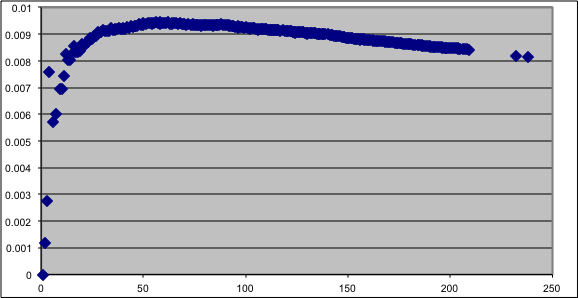
 The Law of Mechanics